Hospital Responsive Website
A responsive Next.js website for Seoul Baekgang Hospital, combining contemporary design, smooth interactions and clear appointment and inquiry pathways across desktop and mobile. SEO and GEO settings were incorporated to help search engines and AI-powered search services access and interpret hospital information. The project brings visual design, patient usability and search accessibility together.
Challenge
Strategy
Execution
Results
Easy for Patients to Use, Clear for Search Engines and AI to Understand
The Seoul Baekgang Hospital website was created to express the hospital’s identity while helping patients find information and move naturally toward appointment requests and inquiries.
Built with Next.js, the responsive website combines contemporary design with SEO and GEO settings. The project considers both the visitor experience and how hospital information can be accessed and interpreted through search and AI-powered search services.
Responsive Design for Desktop and Mobile
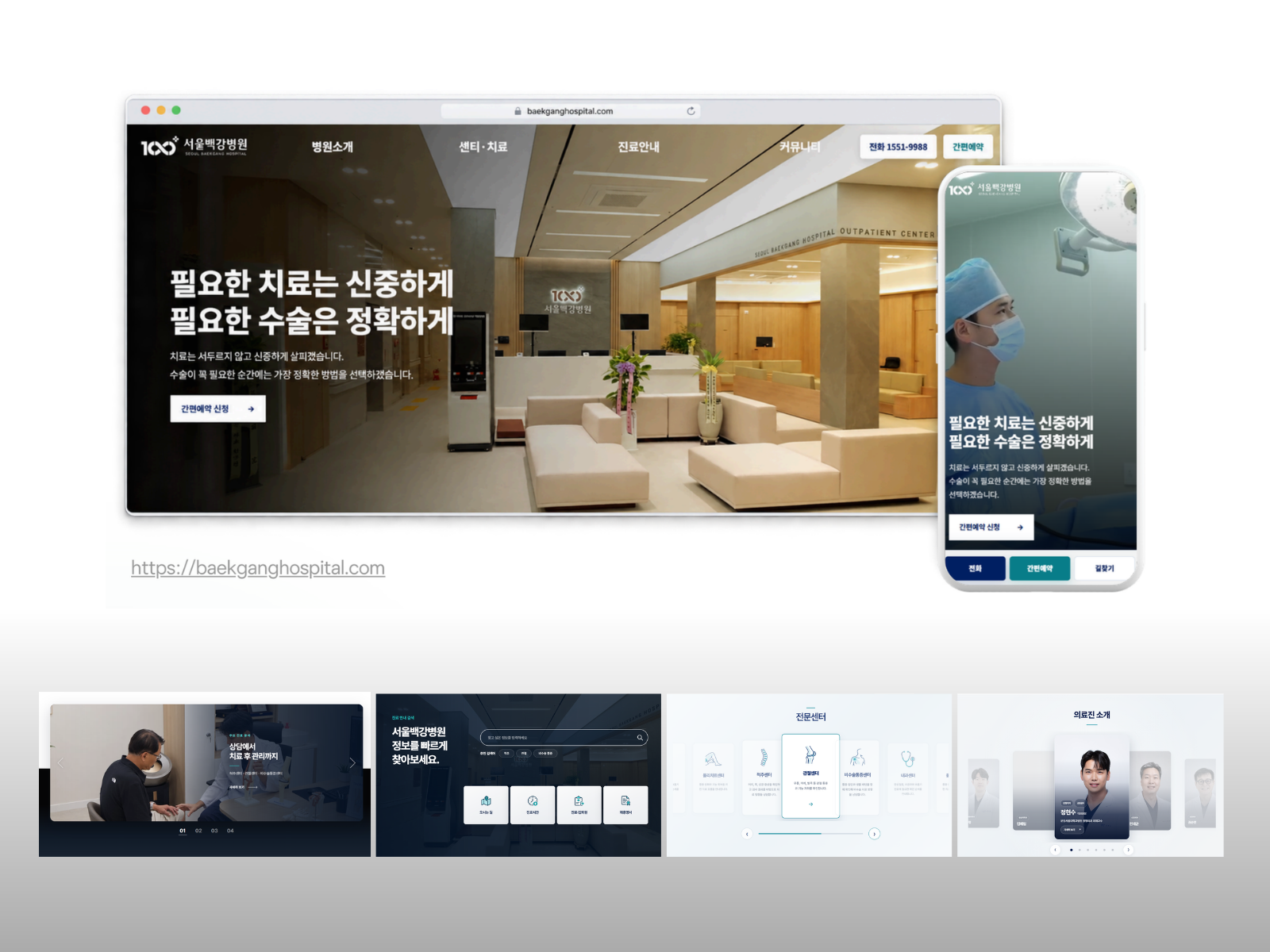
The website adapts content and navigation to different screen sizes rather than simply scaling down the desktop layout.
Desktop pages give the hospital’s imagery and key information room to breathe. Mobile layouts prioritize readable content and convenient access to essential functions.
Contemporary Design and Fluid Interactions
Hospital imagery, brand colors and clear typography establish a cohesive visual identity. Card-based layouts and considered spacing organize care specialties and clinician profiles into manageable sections.
Navigation and scrolling were treated as part of the overall design. The focus was on responsive interactions and smooth movement between sections, allowing visual presentation and information discovery to work together.
From Information to Appointments and Inquiries
The patient journey connects care information and clinician profiles with clear next steps.
Appointment and inquiry options are placed where visitors can find them easily. On mobile, direct access to calling, appointment requests and directions supports common tasks.
The aim was not simply to highlight booking buttons, but to create a clear path from understanding the hospital’s services to making contact.
SEO and GEO for Search and AI Accessibility
The project considers not only how visitors use the website, but also how search engines and AI-powered search services access and interpret its information.
SEO and GEO settings were incorporated to support the discovery and understanding of key hospital information, including care specialties, clinician profiles and visitor guidance.
Here, “AI-friendly” describes an approach that helps make information accessible and understandable to AI-powered search services. It does not promise search rankings or AI recommendations; it establishes a foundation for information discovery and interpretation.
Design, Development and Search Accessibility Together
MEDISEE.NET brought together content structure, visual design, Next.js development, responsive layouts, appointment and inquiry pathways, and SEO and GEO settings.
The finished website combines the hospital’s brand identity with patient-centered usability and a considered approach to search and AI accessibility.